

 September 15, 2026
CTV Is More Than an Awareness Driver.
It’s a Performance Multiplier.
Today, the question isn’t whether CTV works. It’s whether we’re measuring its full impact.
In Nielsen’s 2025 Annual Marketing Report, more than half (56%) of global marketers said they plan to increase Connected TV (CTV) investment, yet only 32% report measuring media holistically across traditional and digital channels. That gap leaves marketers with a significant blind spot, making it difficult to understand CTV’s true impact.
For years, CTV has been treated as an awareness channel. Success was measured in reach, impressions, and video completion rates. Those metrics show who saw the ad–not whether it moved the business. As streaming commands a larger share of television viewing and CTV investment grows, our attribution model needs to evolve beyond exposure alone.
Stop Measuring CTV Like a Click-Based Channel
One of the biggest mistakes marketers make is measuring CTV like Search or Paid Social. But consumers don’t typically see a TV ad and immediately click “Buy Now.”
Instead, they may ask ChatGPT for recommendations, visit the website directly, read reviews, browse retailer sites, or eventually convert through an entirely different channel–perhaps after being retargeted on social media.
When that happens, Search gets the credit. Direct gets the credit. Organic gets the credit. And CTV disappears from the story.
Google’s research has shown that TV exposure can drive incremental search activity, connecting video exposure to downstream consumer intent.
The takeaway? CTV’s value shouldn’t be measured only by the conversions directly attributed back to the channel. Marketers also need to measure the demand it creates and how that demand impacts everything that comes next.
The CTV Ripple Effect
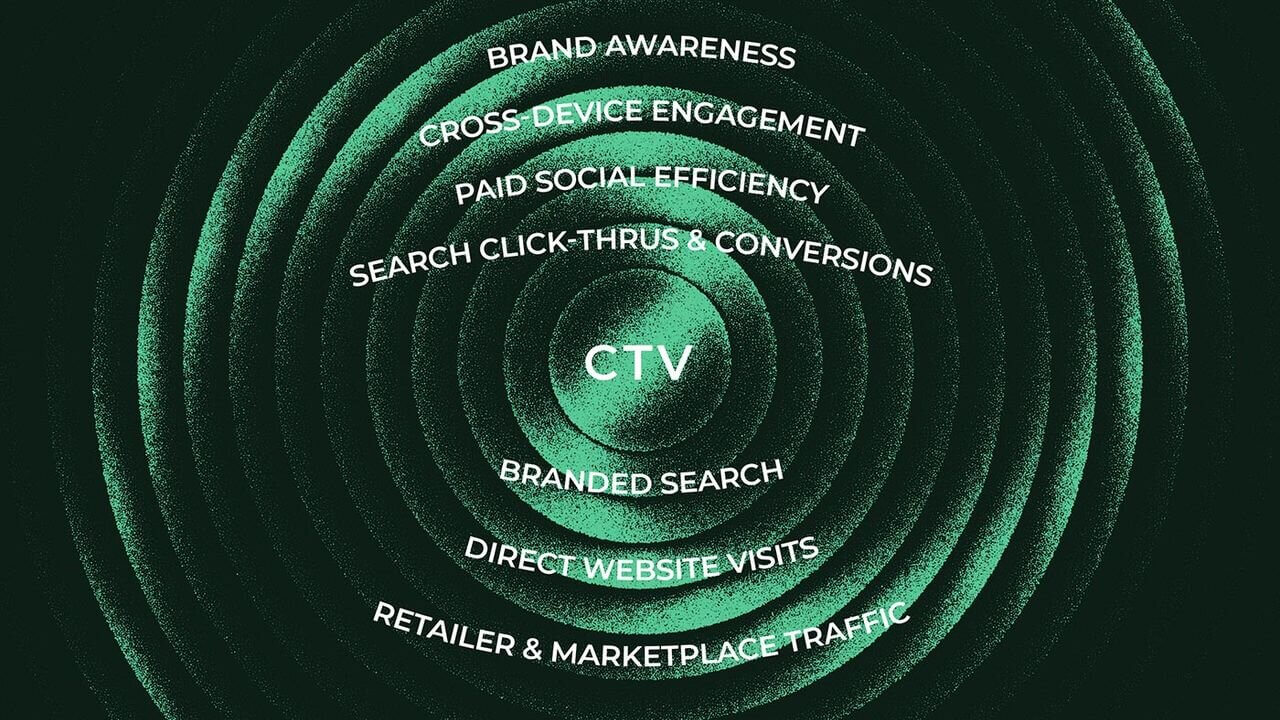
Rather than expecting CTV to behave like a direct-response channel, marketers should investigate whether exposure affects the remaining media mix.
CTV’s impact can show up through signals such as:
- Increased branded search volume
- Higher Search click-through and conversion rates
- More direct website visits
- Better Paid Social efficiency
- Increased retailer and marketplace traffic
- Increased cross-device engagement
- Measurable lift in brand awareness, consideration, or perception
These aren’t secondary effects. They’re part of CTV’s performance story. If CTV creates engagement and demand that ultimately converts elsewhere, evaluating only the final touchpoint misses its true contribution.
We’ve seen that impact firsthand at EMG.
As Scott Lepkofker, EMG’s Chief Media Officer, notes,
“When we analyze the full path to conversion, not just the last touch, we’ve seen CTV become a true driver of incrementality across the broader media ecosystem, including a 75% contribution to Paid Search and a 45% increase in Paid Social. It reinforces an important point: CTV shouldn’t be viewed as a siloed upper-funnel channel. It creates measurable downstream impact across the channels responsible for conversion.“
CTV isn’t simply an awareness channel; it’s a performance multiplier.
Measuring CTV’s Full Impact

Traditional CTV reporting often follows a linear path:
CTV Campaign → Reach → Frequency → Video Completions → Attributed Conversions
But consumer behavior isn’t linear. Rather than asking which single channel deserves credit, we should ask: What role did each channel play in creating the outcome?
At EMG, we look beyond CTV’s isolated channel metrics to understand what changed across the media ecosystem once CTV entered the mix. That means asking:
- Did branded search increase?
- Did Search and Paid Social become more efficient?
- Did direct or retailer traffic grow?
- Did conversion rates and revenue improve?
Because, we’re not just measuring performance within CTV. We’re measuring performance because of CTV. That distinction reveals the halo effect that traditional platform reporting can miss.
Moving from Attribution to Investment Decisions
Understanding CTV’s broader impact is only part of the equation. Marketers also need to know what that impact means for future investment.
Advanced measurement approaches like Marketing Mix Modeling (MMM) can help. MMM shows how CTV contributes to business outcomes alongside other channels. It can also reveal incremental value, diminishing returns, and how investment should shift across channels to maximize overall performance.
As Lepkofker explains,
“I think of CTV as performance branding. The real opportunity comes when you stop evaluating CTV in isolation and instead look at how all media channels work together to drive business outcomes. Advanced measurement allows us to understand those interactions and identify where channels are creating incremental value versus simply capturing demand that already existed.
That perspective can fundamentally change how marketers allocate budgets. Rather than optimizing each channel independently based on platform-reported performance, we can optimize the entire media mix around the outcomes that matter most to the business. In our experience, that has allowed us to shift investment and unlock significantly more value from the same overall budget.”
Ultimately, the goal isn’t to assign more value to CTV. It’s to make smarter investment decisions across the media mix.
The Real Value of CTV

CTV’s value goes beyond what happens on the television screen. It can drive searches, build familiarity that improves a Paid Social response, and create demand that converts through other channels.
That’s why CTV is more than an awareness channel. It’s a performance multiplier.
As investment in streaming grows , measurement needs to evolve with it. Instead of asking: “Did CTV drive the conversion?“, we should ask: “What changed across the rest of the media mix because CTV was there?“. Looking at CTV through this broader lens reveals its true performance impact and helps marketers make smarter decisions.
Are you ready to build a connected TV advertising strategy? Get in touch and we’ll show you how CTV can integrate and impact the full funnel.